
Trigger sprayer capper
Automatic Trigger Sprayer Capper for Cleaning and Care Bottles
Automatic trigger sprayer capping system for bottles where the closure, dip tube and bottle presentation all need to be controlled.
- Output
- 1,200 BPH
- Cap
- Trigger sprayer, customizable
- Container
- Bottle size customizable
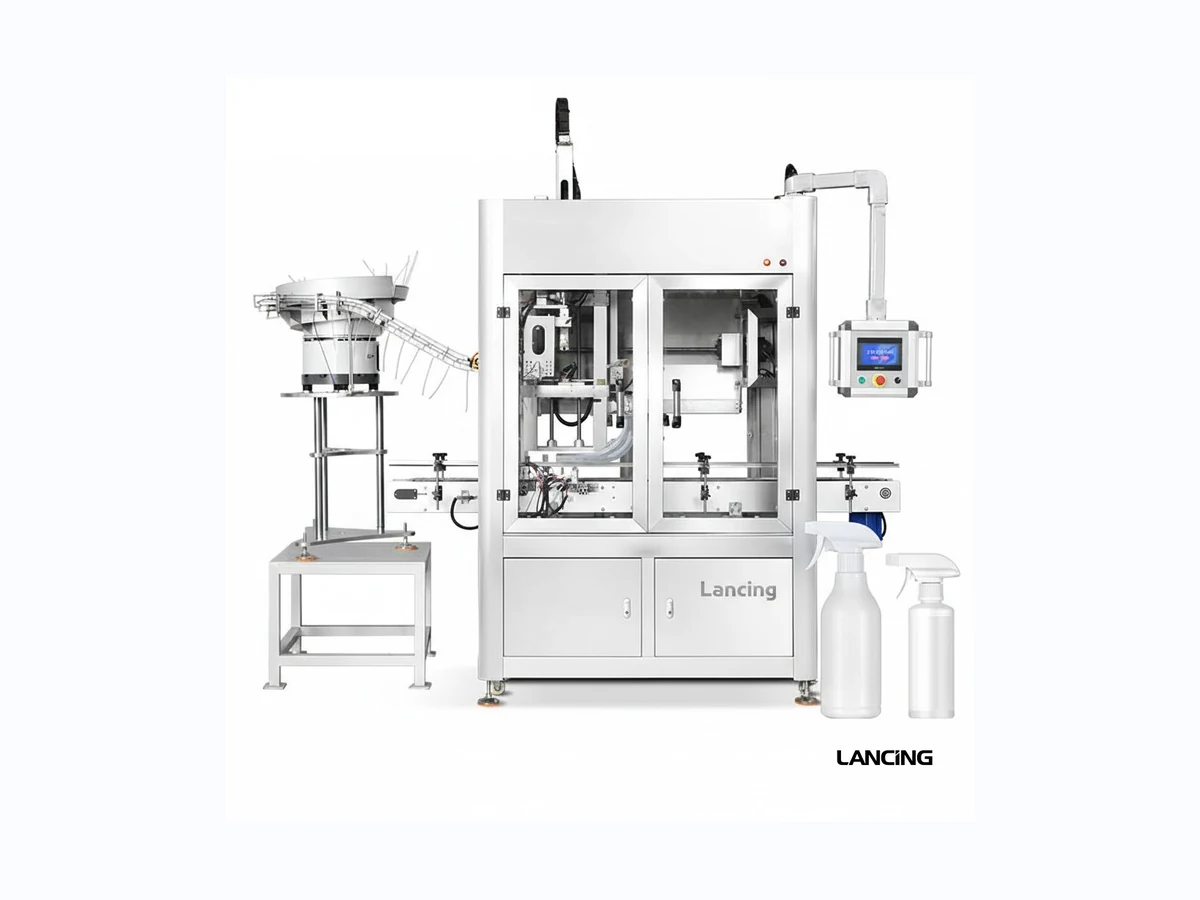
Machine overview
Where this capper fits
Automatic trigger sprayer capping system for bottles where the closure, dip tube and bottle presentation all need to be controlled.
- Built for trigger sprayer closure projects where cap presentation matters.
- Can be configured around bottle family and trigger format.
- Helps reduce manual handling of awkward closures and dip tubes.
- Best planned together with cap feeding, container stability and line layout.
Technical specifications
| Capacity | 1,200 BPH |
|---|---|
| Voltage | 110V/220V |
| Applicable cap | Trigger sprayer, customizable |
| Applicable bottle size | Customizable |
| Conveyor | 2400 × 114 mm, VFD |
| Size | 3264 × 1345 × 2850 mm |
See capping in context
Plan the complete capping cell, not only the base machine.
For reliable production, the capping unit should be matched to bottle stability, cap feed, changeover frequency, torque expectation and the wider line layout.
Send your bottle and cap detailsApplications
Typical uses
Enquiry checklist
Information to send for this machine.
The fastest way to confirm suitability is to send clear product, bottle and closure information with the expected output and available line space.
- Photos or samples of the bottle and cap.
- Target output in bottles/min or bottles/hour.
- Cap torque requirement or current acceptable torque range.
- Whether caps will be manually placed or automatically fed.
- Available space, conveyor details and downstream equipment.
Talk to Lancing UK
Check whether this capper is the right fit.
Send the machine name, bottle details, cap details and target output. We will come back with the best route and configuration.
Trigger closure handling
Test the automatic trigger sprayer capper as a complete orientation and capping process.
Trigger closures combine a threaded cap, a large irregular head and a flexible dip tube. Reliable automation therefore depends on more than tightening torque: the feed system must control orientation, prevent tube tangling and present the closure to a stable bottle.
Selection and operating method
The supplied product page describes an automatic trigger sprayer route with a variable-frequency conveyor and a project-specific bottle and closure configuration. Representative trigger assemblies and filled bottles are essential because tube length, stiffness and head geometry affect handling.
Changeover planning should include trigger head geometry, tube length, bottle neck height, bottle guides, conveyor speed and any placement tooling.
Changeover, maintenance and line integration
Inspection should cover the closure feed path, tube-handling elements, grippers, guides, sensors, pneumatic connections and the capping contact surfaces.
Line integration must account for machine height and footprint, bottle spacing, upstream fill condition, downstream backup and safe operator access to the trigger supply.
Published data and test conditions
Use the stated range as a starting point for sample validation.
Values are retained from the supplied first-party product page. They are not a guarantee for every closure or bottle; the representative production pack and agreed acceptance method determine the final configuration.
| Published capacity | 1,200 bottles/hour. |
|---|---|
| Applicable closure | Trigger sprayer, customisable. |
| Applicable bottle | Bottle size customisable. |
| Voltage | 110 V / 220 V. |
| Conveyor | 2400 × 114 mm with variable-frequency drive. |
| Machine size | 3264 × 1345 × 2850 mm. |
Trial and acceptance evidence
Checks that establish usable performance.
Trigger orientation
Record whether each head reaches the agreed orientation before placement and whether wrong-way closures are rejected or recovered.
Dip-tube handling
Use production-length tubes and observe tangling, bending, snagging and entry into the bottle neck.
Bottle stability
Run filled bottles at the intended conveyor speed and check tilt, twist, guide contact and cap start.
Capping quality
Check thread engagement, removal torque or approved integrity criteria, visual head position and bottle or closure damage.
Feed interruption
Starve or stop the closure feed, then verify detection, safe access and controlled restart.
Sustained rate
Measure over a representative run that includes trigger replenishment and normal operator intervention.
When another technology may be more suitable
For manually presented triggers or lower-volume work, an inline screw capper or semi-automatic route may be more practical. Pump closures and standard caps can have different handling needs; use the specialist domain rather than assuming one feeder fits every closure.
Related pages
- Trigger cap feeder — Review the supplied vibratory and pneumatic feed route.
- Cap feeding systems — Compare feed and recovery methods.
- Bottle stability — Plan guide and filled-sample checks.
- Risk assessment — Review jams, access and line interfaces.
- Trigger capping specialist — Use for the wider trigger and dip-tube handling category.
Buyer questions
Questions to resolve before final specification.
Why are trigger sprayers difficult to automate?
The irregular head and flexible dip tube affect sorting, orientation, placement and thread start.
Is 1,200 bottles/hour guaranteed?
It is the published capacity for the machine page; the actual sustained rate must be proven with the project trigger and bottle.
Does tube length matter?
Yes. Tube length, stiffness and curvature can change tangling and bottle entry behaviour.
Can bottle sizes be changed?
The page states that bottle size is customisable. The actual format range and change parts should be agreed during sample testing.
What should happen after a feed jam?
The system should stop safely, allow controlled access and return to correct single-closure presentation without damaging the next packs.
What is a useful acceptance check?
Combine sustained output with orientation, thread engagement, torque or integrity checks, visible damage and recovery from normal interruptions.
Specification support
Send representative samples for a configuration review.
Include representative bottle and closure samples, the required output, any known torque or closure-integrity checks, the cap presentation method and photographs of the proposed line area.
Trigger trial plan
Test closure handling at the published condition with production components.
The published capacity is 1,200 bottles/hour and applicable trigger and bottle size are customisable. Confirm trigger, dip tube, filled bottle, final orientation and pack-quality method before treating capacity as the acceptance condition.