
Cap feeding support
Trigger Spray Cap Feeder and Lid Feeding Equipment
Cap feeding equipment for trigger spray caps with soft dip tubes, using vibratory sorting, conveyor handling and pneumatic placement support.
- Output
- 20–25 BPM
- Cap
- Suitable cap size approx. Ø 15–35 mm
- Container
- Bottle height approx. 10–280 mm
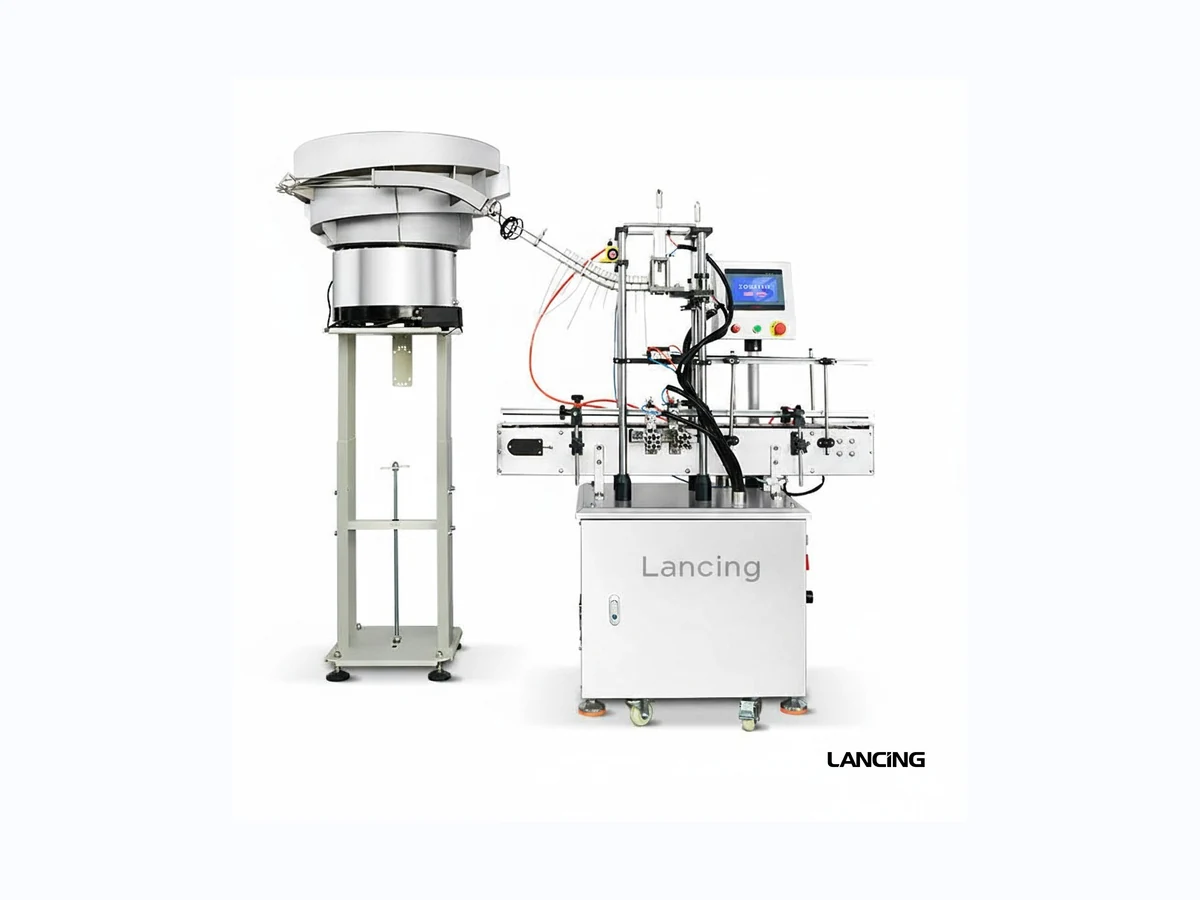
Machine overview
Where this capper fits
Cap feeding equipment for trigger spray caps with soft dip tubes, using vibratory sorting, conveyor handling and pneumatic placement support.
- Vibratory bowl feeder sorts and presents trigger spray caps.
- Pneumatic gripper supports pick-and-place cap handling.
- Straightening gripper helps guide soft dip tubes before placement.
- Useful where the cap feed challenge is the limiting step in the capping process.
Technical specifications
| Machine model | LU-XG446S |
|---|---|
| Voltage | 110/220V 50–60Hz 250W |
| Suitable cap size | Approx. Ø 15–35 mm |
| Suitable bottle height | Approx. 10–280 mm |
| Working capacity | 20–25 BPM |
| Package size | Approx. 1420 × 680 × 1740 mm main machine + 940 × 930 × 820 mm vibratory bowl sorter |
| Package weight | Approx. 210 kg main machine + 153 kg vibratory bowl sorter |
See capping in context
Plan the complete capping cell, not only the base machine.
For reliable production, the capping unit should be matched to bottle stability, cap feed, changeover frequency, torque expectation and the wider line layout.
Send your bottle and cap detailsApplications
Typical uses
Enquiry checklist
Information to send for this machine.
The fastest way to confirm suitability is to send clear product, bottle and closure information with the expected output and available line space.
- Photos or samples of the bottle and cap.
- Target output in bottles/min or bottles/hour.
- Cap torque requirement or current acceptable torque range.
- Whether caps will be manually placed or automatically fed.
- Available space, conveyor details and downstream equipment.
Talk to Lancing UK
Check whether this capper is the right fit.
Send the machine name, bottle details, cap details and target output. We will come back with the best route and configuration.
Cap feeding and recovery
Validate the LU-XG446S feeder with normal production triggers and dip tubes.
The supplied feeder uses vibratory sorting, conveyor handling, pneumatic placement and a straightening gripper for soft dip tubes. Its value depends on stable single-closure presentation and reliable recovery, not only the nominal bottles-per-minute figure.
Selection and operating method
Trigger assemblies can nest, tangle and arrive in inconsistent orientation. The bowl and downstream tooling should therefore be evaluated with caps from normal production supply, including dimensional variation and tubes stored as they will be presented on site.
Format control should document bowl and track settings, guide positions, air settings, gripper timing, tube straightener position and the interface point to the capper.
Changeover, maintenance and line integration
Routine inspection should cover the bowl track, tooling gates, sensors, gripper surfaces, pneumatic fittings and any areas where caps or tubes can catch.
The line controls should define low-cap response, feeder stop, downstream backup and whether closures remain safely controlled during an emergency stop.
Published data and test conditions
Use the stated range as a starting point for sample validation.
Values are retained from the supplied first-party product page. They are not a guarantee for every closure or bottle; the representative production pack and agreed acceptance method determine the final configuration.
| Machine model | LU-XG446S. |
|---|---|
| Published capacity | 20–25 bottles/min. |
| Suitable cap size | Approx. Ø 15–35 mm. |
| Suitable bottle height | Approx. 10–280 mm. |
| Electrical data | 110/220 V, 50–60 Hz, 250 W. |
| Published packed dimensions | Main machine approx. 1420 × 680 × 1740 mm; bowl sorter approx. 940 × 930 × 820 mm. |
| Published packed weight | Main machine approx. 210 kg; bowl sorter approx. 153 kg. |
| Handling method | Vibratory sorting, pneumatic gripper and dip-tube straightening support. |
Trial and acceptance evidence
Checks that establish usable performance.
Bulk-feed behaviour
Fill the bowl to normal operating level and check tangling, nesting, recirculation and whether damaged closures enter the track.
Single-cap delivery
Confirm that the outlet presents one correctly orientated trigger at the required spacing without doubles or gaps.
Tube straightening
Observe soft tubes through normal variation and check that they enter the bottle without folding or snagging.
Low-level recovery
Allow the feeder level to fall, replenish it and record how quickly stable flow returns.
Jam recovery
Create representative misfeeds, then record detection, operator access, clearing time and first-off quality after restart.
Capper interface
Verify the timing and physical handover to the downstream capping head across stop/start and line-speed changes.
When another technology may be more suitable
A standard cap elevator or simpler chute may be preferable for regular screw caps that do not need trigger-head orientation or dip-tube control. Detailed feeder design for other cap families belongs on the cap-feeder specialist resource.
Related pages
- Trigger sprayer capper — Connect the feeder to the automatic trigger capping route.
- Cap feeding systems — Compare bowl, elevator, chute and manual feed options.
- Cap feeder options — Review selection variables and sample requirements.
- Risk assessment — Plan safe jam access and recovery.
- Cap feeder specialist — Use for detailed bowl, elevator and singulation projects.
Buyer questions
Questions to resolve before final specification.
What does the LU-XG446S feed?
The supplied page describes trigger spray caps with soft dip tubes, subject to sample and size confirmation.
What is the published working capacity?
The page states 20–25 bottles per minute. Sustained performance depends on the actual trigger, tube and downstream interface.
Why is a straightening gripper used?
It helps guide soft dip tubes so the closure can be placed into the bottle without folding or snagging.
Can any 15–35 mm cap be used?
No. The size is an approximate published range; geometry, head shape, tube and orientation must be tested.
How should recovery be tested?
Test low cap level, a mis-oriented trigger, a tube snag and a downstream stop, then record safe clearing and return to correct feed.
What samples are needed?
Provide triggers and tubes from normal production supply, empty and filled bottles, target rate and details of the downstream capper.
Specification support
Send representative samples for a configuration review.
Include representative bottle and closure samples, the required output, any known torque or closure-integrity checks, the cap presentation method and photographs of the proposed line area.
LU-XG446S trial plan
Validate the published feeder range with the actual trigger and bottle family.
The published capacity is 20–25 bottles/min, with an approximate cap range of 15–35 mm and bottle height of 10–280 mm. Test sorting, pneumatic gripping, dip-tube straightening, bottle presentation and restart using production assemblies and filled bottles.