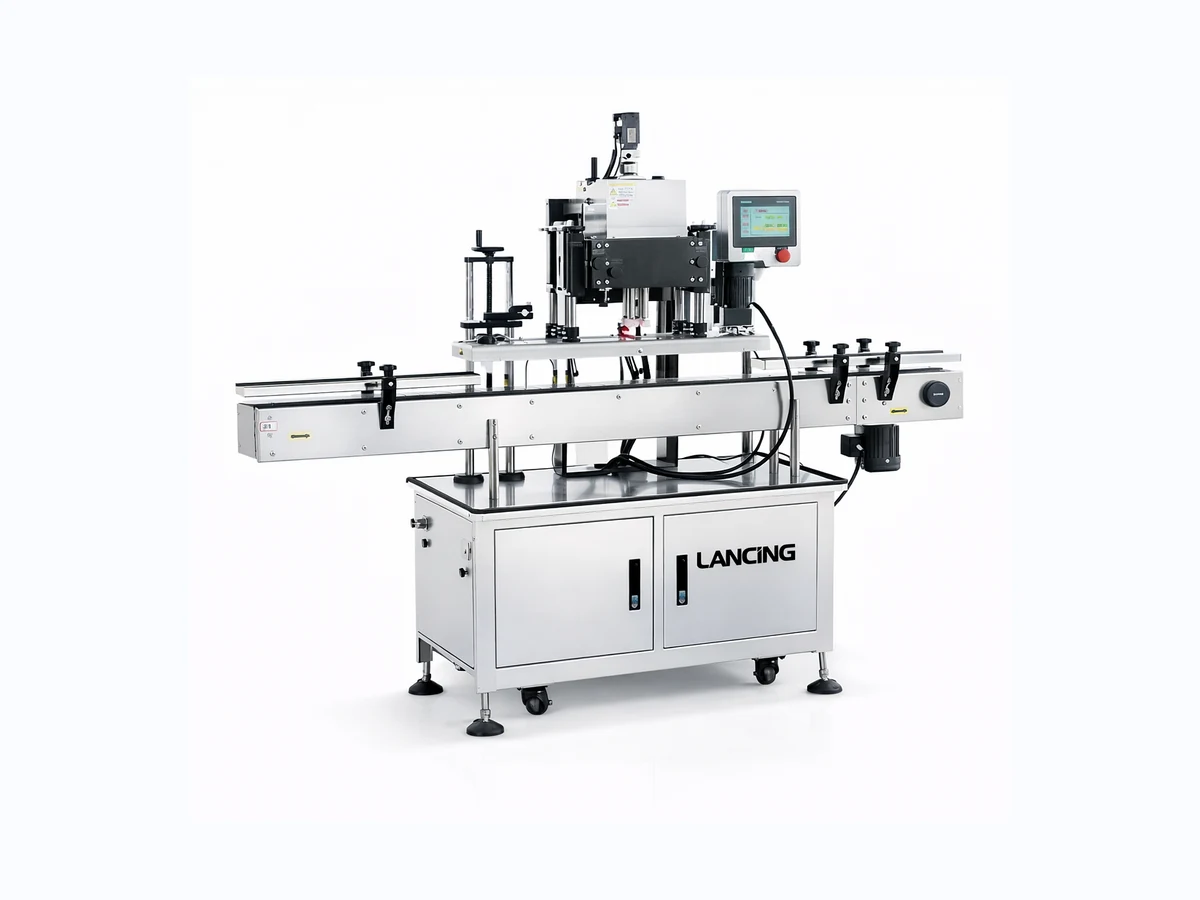
Inline spindle capper
Uses side belts and spindle wheels to tighten caps as bottles pass through the machine. A common route for stable round bottles and threaded screw caps.

Automatic bottle capping
Automatic bottle capping systems for production lines that need repeatable cap tightening, bottle handling and integration with filling, labelling and outfeed.
Line fit
Automatic bottle capping machines are usually selected when the production process needs more than a bench-top torque head. The capper may need side belts, infeed/outfeed conveyors, cap feed, cap pickup, guide rails, torque control and changeover tooling for multiple bottle sizes.
The best route depends on whether the closure is a simple screw cap, a pump, a trigger sprayer, a ROPP-style closure or another specialist cap. Lancing UK can review the bottle, closure, output target and surrounding line stages to check which route is realistic.
Automatic capping routes
Uses side belts and spindle wheels to tighten caps as bottles pass through the machine. A common route for stable round bottles and threaded screw caps.
Useful where the cap style, bottle format or changeover requirement needs a more flexible inline capping arrangement.
Designed around closures with dip tubes or pump assemblies where cap orientation and bottle presentation are critical.
Project risks
| Issue | Why it matters | How to reduce risk |
|---|---|---|
| Unstable bottles | Bottles can tilt or slip during cap pickup and tightening. | Check side belts, guide rails, bottle support and conveyor transitions with samples. |
| Cap variation | Small cap differences can affect thread start, torque and feed reliability. | Test real caps from the intended supplier and note acceptable tolerance. |
| Under-specified cap feeding | Output can be limited if the cap feed cannot present caps consistently. | Match the feed route to the cap style, orientation and target bottles per minute. |
Related routes
Ready to shortlist?
Lancing UK will help identify the most practical capping route and quote the right machinery scope.
Automatic line decision
An automatic project can include cap orientation, placement, bottle stabilisation, tightening, inspection and rejection as well as the base capper. The scope depends on whether caps arrive loose or pre-placed, how the bottle behaves when held and what the line must do when caps or bottles are temporarily unavailable.
Inline spindle capping suits threaded closures that can be presented squarely and tightened progressively.
Dip tubes and off-centre heads can require specialist placement, straightening and bottle control.
A compact or semi-automatic machine may be more practical when operator loading and flexibility matter most.