
Compact Series
Compact Desktop Screw Capping Machine
Space-saving compact capper for sprays and screw caps, designed for operations that need repeatable torque without a large automatic line.
- Output
- Approx. 20–40 bottles/min
- Cap
- Cap Ø 18–70 mm
- Container
- Bottle height 60–270 mm
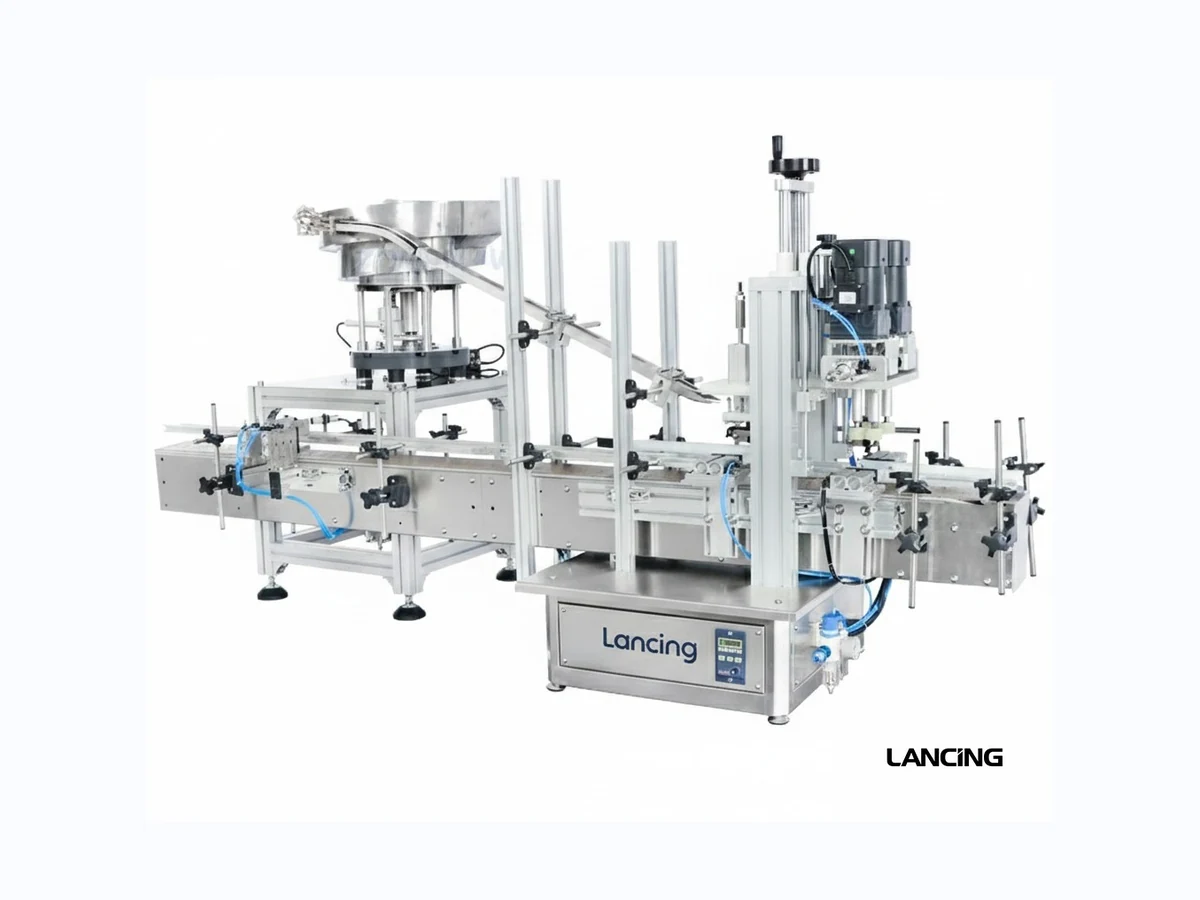
Machine overview
Where this capper fits
Space-saving compact capper for sprays and screw caps, designed for operations that need repeatable torque without a large automatic line.
- Compact footprint for limited production space.
- Designed for consistent torque on common screw closures.
- Good route between manual tightening and a fully automatic capper.
- Can be specified around your bottle height, closure type and expected output.
Technical specifications
| Output | Approx. 20–40 bottles/min, typical |
|---|---|
| Cap range | 18–70 mm |
| Bottle height | 60–270 mm |
| Closure types | Sprays and screw caps |
| Best suited to | Compact production cells and growing lines |
See capping in context
Plan the complete capping cell, not only the base machine.
For reliable production, the capping unit should be matched to bottle stability, cap feed, changeover frequency, torque expectation and the wider line layout.
Send your bottle and cap detailsApplications
Typical uses
Enquiry checklist
Information to send for this machine.
The fastest way to confirm suitability is to send clear product, bottle and closure information with the expected output and available line space.
- Photos or samples of the bottle and cap.
- Target output in bottles/min or bottles/hour.
- Cap torque requirement or current acceptable torque range.
- Whether caps will be manually placed or automatically fed.
- Available space, conveyor details and downstream equipment.
Talk to Lancing UK
Check whether this capper is the right fit.
Send the machine name, bottle details, cap details and target output. We will come back with the best route and configuration.
Compact automation
Confirm that the compact screw capper fits the pack, bench workflow and utilities.
The compact route sits between manual or bench tightening and a larger automatic line. It is useful where floor space is limited and repeatable capping is required, but the published speed still depends on how bottles and caps are presented to the machine.
Selection and operating method
The stated range covers sprays and screw caps with a compact conveyor-based arrangement. The project review should therefore consider operator loading, bottle transfer, cap placement, bottle height adjustment and how finished packs leave the cell.
Record guide positions, cap-tooling selection, height and conveyor speed for each format. Compact machines are often used for varied work, so setting control is important.
Changeover, maintenance and line integration
Cleaning and inspection should cover cap-contact surfaces, guides, conveyor, sensors and any clamp or pneumatic components.
Allow space for the operator, cap supply, uncapped bottles, finished packs and maintenance access rather than measuring the machine footprint alone.
Published data and test conditions
Use the stated range as a starting point for sample validation.
Values are retained from the supplied first-party product page. They are not a guarantee for every closure or bottle; the representative production pack and agreed acceptance method determine the final configuration.
| Published output | Approx. 20–40 bottles/min, typical. |
|---|---|
| Cap range | 18–70 mm. |
| Bottle height | 60–270 mm. |
| Closure types | Sprays and screw caps. |
| Installation context | Compact production cells and growing lines. |
| Acceptance condition | Final speed and torque performance require representative bottle and cap trials. |
Trial and acceptance evidence
Checks that establish usable performance.
Bench workflow
Time bottle loading, cap placement, tightening and outfeed under normal operator conditions.
Bottle transfer
Check that containers enter and leave without tipping, catching guides or colliding at the outfeed.
Cap fit
Use production closures and inspect thread start, contact marking and cap finish.
Torque and integrity
Test removal torque or the approved pack method over a defined batch, including after normal line handling.
Utilities
Confirm electrical supply and any pneumatic requirement for the selected configuration.
Future formats
Include planned bottles and caps so the adjustment range and change parts do not restrict growth.
When another technology may be more suitable
A semi-automatic capper may be better for very short or highly varied batches. A full inline spindle capper may be more suitable where output, automatic cap feeding and integration with filling or labelling are the main requirements.
Related pages
- Semi-automatic capper — Compare the lower-volume clamped bench route.
- Automatic screw capper — Review the wider inline bottle and closure range.
- Installation readiness — Plan access, utilities and operator space.
- Changeover checklist — Create repeatable format records.
- Screw capping specialist — Review wider compact and screw-cap equipment.
Buyer questions
Questions to resolve before final specification.
Is the compact capper fully automatic?
It is a compact production route, but the exact bottle and cap presentation method depends on the supplied configuration.
What does the 20–40 bottles/min figure assume?
It is a typical published range. Sustainable output depends on pack handling, operator tasks, cap placement and line conditions.
Can it handle sprays?
The supplied page lists sprays and screw caps, subject to sample and tooling confirmation.
How much space should be allowed?
Allow the machine footprint plus safe operator working space, cap and bottle supply, outfeed and maintenance access.
Can it be expanded later?
Future integration depends on the selected controls, conveyor and pack range, so planned growth should be included in the original brief.
What samples should be tested?
Use normal production caps, empty and filled bottles, labels where fitted, and the smallest, largest and least stable planned formats.
Specification support
Send representative samples for a configuration review.
Include representative bottle and closure samples, the required output, any known torque or closure-integrity checks, the cap presentation method and photographs of the proposed line area.
Compact production cell
Plan operator loading, bottle location and downstream handling together.
The published route is approximately 20–40 bottles/min as a typical condition, with an 18–70 mm cap range and 60–270 mm bottle height. Final speed and torque require representative trials. Include loading pattern, accumulation, quality checks and the route into labelling or packing.